QPT launches motor drive testbed for collaborative robots
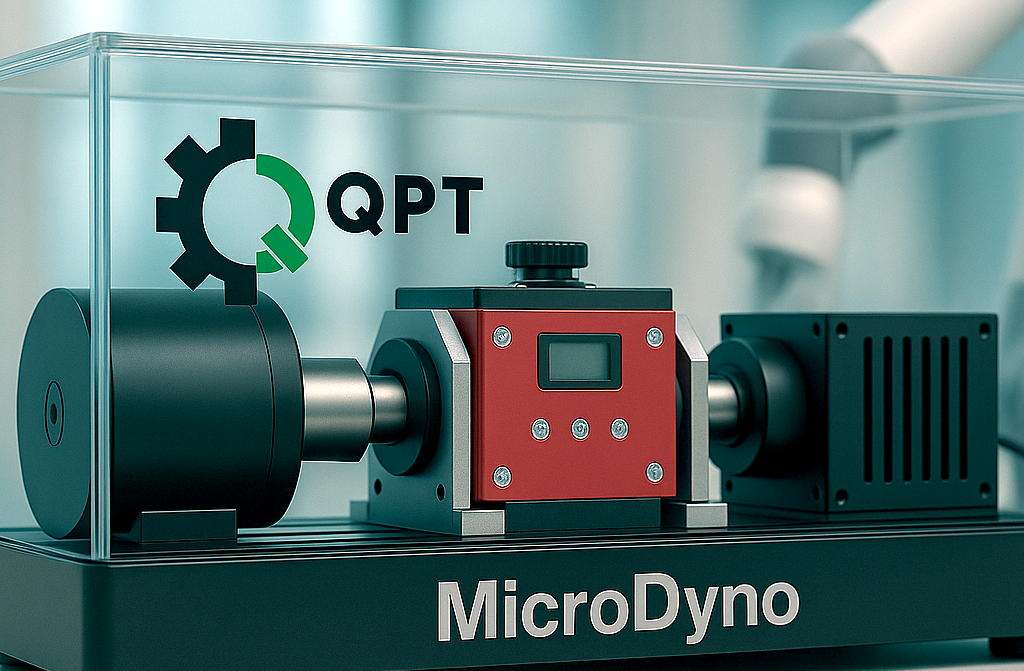
QPT’s MicroDyno test platform demos how GaN technology can improve the performance of cobot motors. | Credit: QPT
QPT has introduced MicroDyno, a low-voltage motor drive test platform that demonstrates the performance of ultra-high frequency GaN-based motor drives. The platform is designed to provide improved control and efficiency while reducing system complexity and cost, with applications in the growing collaborative robot (cobot) market.
Operating at 1 MHz switching speeds, MicroDyno integrates a compact filter to deliver a true sine wave voltage to motors. While QPT‘s IP scales up to high power, this low-voltage platform will be used to show how it can transform the performance of cobots and general robotics through the dynamic correction of torque cogging and torque ripple, and high-fidelity sensing within the drive. All of this is achieved without expensive external sensors or encoders to both significantly reduce the costs of these systems whilst also hugely improving the performance over standard PWM-based systems.
Most current robotic drives operate at 4–16 kHz PWM frequencies, shaping current into a sine wave but leaving the voltage at the motor as high dv/dt PWM. Some specialist systems reach 100 kHz, but these face electromagnetic challenges and are still too low frequency to enable small, cost-effective filtering required for true sine voltage output and EMI filtering.
By extracting the maximum performance from GaN transistors, it is able to operating at around 100x the standard frequency which enables a very small, cheap output filter, producing a clean sine voltage directly at the motor terminals with an extremely high signal-to-noise ratio. This also eliminates EMI, reduces bearing currents, enables “sensing without sensors”, and allows the use of unshielded cables or a fully integrated motor drive — a transformative shift for robotics integration.
Dynamic torque ripple and cogging correction: Real-time compensation using QPT’s integrated qSense technology, detecting voltage and current disturbances in the time and frequency domains thanks to the high signal-to-noise ratio of a sine wave drive.
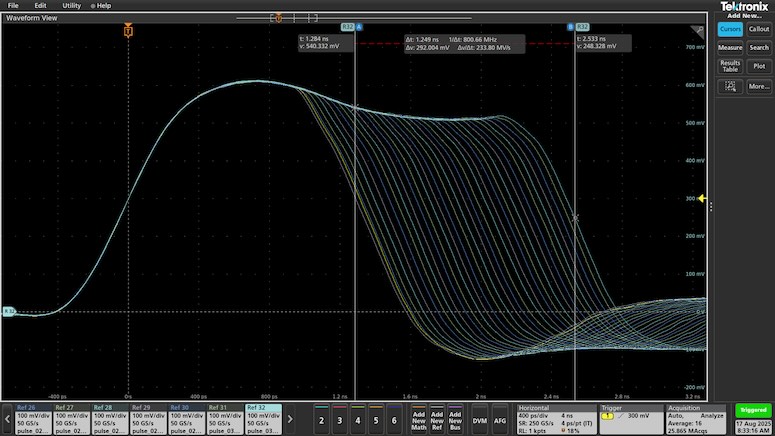
qControl enables 14-bit resolution at 1MHz PWM converter frequency, enabling the high-precision sinewaves. The image shows the pulse width being controlled in 40 picosecond steps. | Credit: QPT
Precision and smoothness: QPT’s qControl technology is capable of generating the 1MHz signals with picosecond accuracy. The tiny filters deliver true sine voltage enabling cleaner control signals, delivering smoother motion critical for delicate assembly and medical robotics.
High-fidelity sensorless diagnostics: Clean sine wave output supports advanced torque and vibration monitoring for advanced sensing and predictive maintenance. The motor drive can detect and report on the cause of any vibrations in the system, all without the need for expensive external sensors.
Compact, lightweight integration: 1 MHz switching reduces filter and drive size, enabling the motor drives to be fully integrated with the motors in the robotic joints.
Lower system and development costs: With the integrated filters, expensive shielded cabling is not required. EMC is also much simpler, motor life is extended, expensive encoders and sensors can be removed, and much higher performance can be achieved from cheaper motors.
AI enabled for next-generation designs: MicroDyno lays the foundation for local AI processing to improve the performance of each motor, and a cloud-based solution to monitor and optimize across a fleet of electric motor systems, such as an entire production line of machine tools or robots.
MicroDyno demonstrates QPT’s architecture at 48V for robotics and cobots, but the underlying technology is fully scalable. Using QPT’s proprietary qAttach packaging, the same high-frequency sine-wave advantages extend to 400V and 800V systems. The sine wave output also unlocks the ability for the design of multiphase modules that can be used in parallel to reach megawatt levels of power with a much smaller range of modules for motor drive OEMs to contend with.